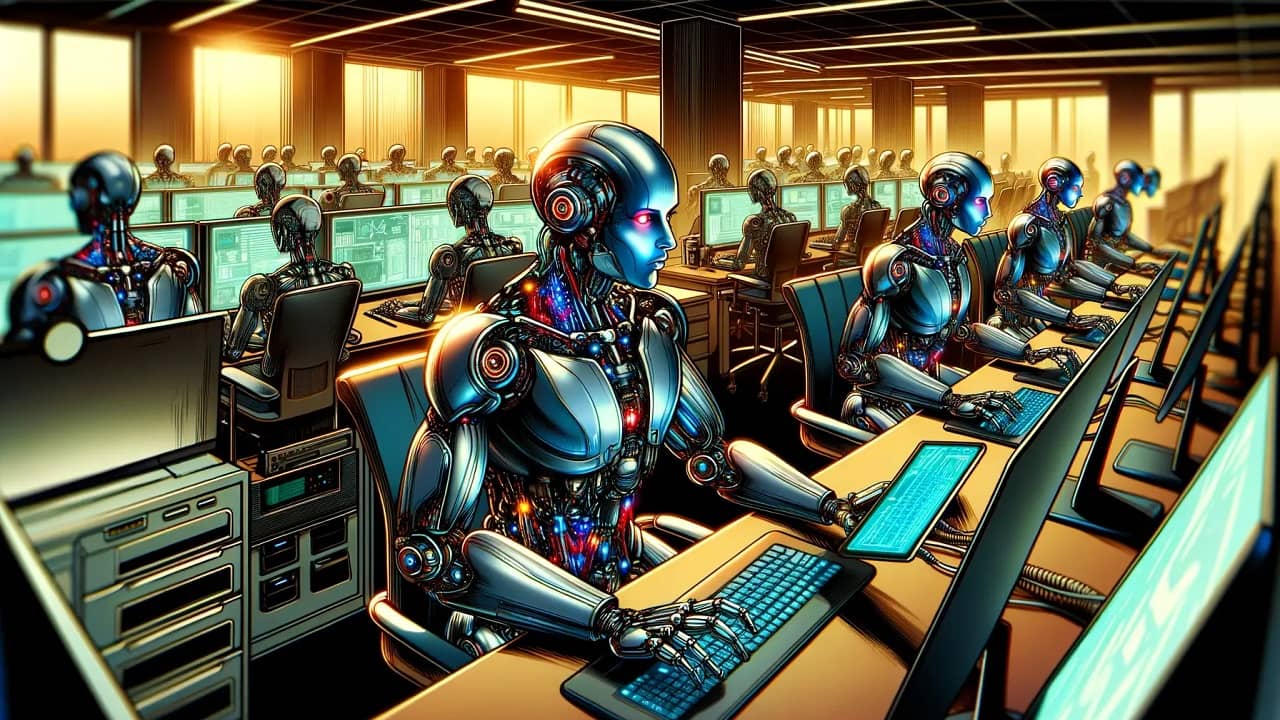
Why Frontend Developers Are the First Target of AI and How to Make Sure You Are Not Replaceable
📧 Subscribe to JS Pulse
The JavaScript job market in one email: real numbers from 600+ job listings, 5 jobs worth applying to, and what actually changed. Join 9,000+ developers.
There is a conversation happening right now in every frontend team, every JavaScript Discord server, and every developer subreddit. It sounds different depending on who is talking, but the core question is the same. Is frontend development dying?
The short answer is no. The longer answer is that frontend development as most people practice it today is changing so fast that it will be unrecognizable within two years. And the developers who understand what is actually changing versus what is staying the same are the ones who will come out of this stronger than ever.
Let me give you some context for why this conversation is louder right now than it has ever been.
The State of JS 2025 survey results came out recently, and while React is still the most used framework, developer satisfaction with frontend frameworks is dropping year over year. That alone would just be normal industry churn. But something else happened at the same time. AI coding tools got remarkably good at generating the exact kind of code that most frontend developers spend their days writing. Components. Layouts. Forms. API integrations. CRUD interfaces. The boilerplate that fills most of a frontend developer's workweek can now be generated in seconds.
Companies noticed. Employment data from Stanford and the Challenger Gray report shows that hiring for frontend and simple coding roles is falling faster than almost any other technical category. Positions most exposed to AI saw employment among young developers drop roughly 20 percent from the 2022 peak. Meanwhile, AI and ML engineering positions grew by 40 percent in 2025. The gap between these two numbers tells a story that no amount of wishful thinking can ignore.
And here is something that makes the situation even more complicated. About 59 percent of hiring managers in recent surveys admitted they use AI as a convenient excuse for layoffs, even when the real reasons are financial. So some of the panic is amplified by companies performing "AI theater" for their investors. Amazon cut another 16,000 people recently. HP announced up to 2,000 reductions. Autodesk and Workday made similar moves. Many of these companies explicitly cited AI optimization in their announcements. But when more than half of hiring managers privately admit the AI reasoning is partly a PR strategy, you have to evaluate the narrative carefully.
The underlying shift is real though. AI is genuinely better at certain frontend tasks than most mid level developers, and that changes the economics of how teams are built.
This article is not here to add to the panic. There are enough doom threads on Twitter already. This article is here to give you a clear, practical map of which frontend skills are being commoditized, which ones are becoming more valuable, and exactly what to do about it whether you are currently employed or looking for your next role.
What AI Can Already Do Better Than Most Frontend Developers
Before we talk about what makes you irreplaceable, we need to be honest about where AI already wins. Pretending that AI is bad at frontend work is a losing strategy because it is not bad at it. For certain tasks, it is already faster and more consistent than the average developer.
Generating standard components. Give an AI a description of a data table with sorting, filtering, and pagination, and you will get a working component in under a minute. It will handle the basic edge cases. It will be reasonably well structured. Two years ago, that was a full day of work for a mid level developer. Now it takes sixty seconds and a good prompt.
Writing boilerplate and repetitive code. Form validation, API service layers, Redux slices, utility functions, type definitions from API schemas. AI excels at this because the patterns are well established and the solutions are standardized. If a significant portion of your daily work consists of writing code that follows a predictable pattern, AI can do that part faster than you can type the first line.
Converting designs to markup. The latest generation of AI tools can take a Figma design and produce a reasonable first pass of the HTML and CSS. It is not perfect and the code often needs refactoring. But it gets you 60 to 70 percent of the way there in minutes instead of hours.
Writing tests for existing code. AI is surprisingly good at generating unit tests and integration tests for code that already exists. It can identify edge cases, generate test data, and produce test suites that would take a human developer hours to write manually.
Debugging common issues. Pass an error message and the surrounding code to an AI, and it will frequently identify the problem faster than you would by reading through the code yourself. Stale closures, missing dependency arrays, incorrect TypeScript types, race conditions in useEffect. AI has seen these patterns millions of times and recognizes them instantly.
Here is why being honest about this matters. If you have built your career identity around being the person who writes components, converts designs to code, and handles boilerplate, your value proposition is shrinking every month. Not because you are doing anything wrong, but because the tasks themselves are being commoditized. The term "vibe coding" recently entered the developer vocabulary, describing developers who write code entirely through prompts without touching the keyboard for actual syntax. It sounds like a joke until you see someone ship a working prototype in an afternoon using nothing but natural language instructions to an AI.
The developers who are thriving right now recognized this shift early and moved their focus to the things AI genuinely cannot do. And there are more of those things than the panic on social media would have you believe.
Understanding Why Users Do What They Do
AI can build a component. It cannot tell you whether that component should exist in the first place.
The most valuable frontend work has always been the thinking that happens before the first line of code is written. Which features actually solve the user's problem? What is the user's mental model, and does the interface match it? Where will users get confused, not because the interface has a bug, but because the information architecture does not align with how they think?
This kind of product thinking requires understanding of human psychology, business context, and domain expertise that AI simply does not have. AI does not know your users. It does not know that your target audience is truck drivers who check the app while standing at a loading dock, which means touch targets need to be larger and text needs to be readable in bright sunlight. It does not know that your B2B dashboard users are accountants who think in terms of fiscal quarters and want to compare year over year data on the same screen. Those insights come from talking to users, watching them use your product, and developing intuition over time.
Frontend developers who can bridge the gap between user needs and technical implementation are not just safe from AI. They are becoming more valuable because AI lets them execute on their insights faster. The bottleneck was always the thinking, not the typing. If you can think well about user experience and now produce the code five times faster, you are worth more to a company than you were two years ago, not less.
The practical shift here is important. Stop thinking of yourself as someone who builds interfaces and start thinking of yourself as someone who solves user problems through interfaces. The difference sounds subtle but it changes everything about how you approach work, how you communicate with stakeholders, and how replaceable you are.
Architectural Decisions That AI Cannot Make For You
When a frontend application grows beyond a handful of screens, the architectural decisions become the primary determinant of whether the codebase stays maintainable or collapses under its own weight. State management strategy. Data fetching patterns. Error handling philosophy. Component composition. Route organization. Performance budgets. These decisions shape everything that follows.
AI can implement any architecture you describe. But it cannot decide which architecture is right for your specific situation. It does not know that your team has three developers who have never used GraphQL, so introducing it now would slow the team down for two months even if it is technically superior. It does not know that your company is planning to spin off one product module into a separate application next year, so the shared component library needs to be designed for extraction from day one. It does not know that your CEO promised a client a feature demo in three weeks, so the architecture needs to support rapid prototyping in one area while maintaining stability everywhere else.
If you have studied how to think about application architecture at a system level, you already have an advantage that AI cannot replicate. The developers who understand why a codebase is structured a certain way, not just how to add features to it, are the ones companies fight to retain during layoffs and fight to hire during expansions.
This is the skill that separates the developer who gets asked to "just build this screen" from the developer who gets asked to "figure out how we should build this entire product." The second developer makes architectural decisions that affect every other developer on the team. AI is not taking that job. AI is making that job more important because bad architectural decisions now propagate faster when AI generates code that follows whatever patterns already exist in the codebase. One wrong structural choice gets multiplied across the entire project in hours instead of weeks.
Performance Optimization That Requires Human Judgment
AI can tell you that your Largest Contentful Paint is 4.2 seconds. It can even suggest some common fixes. What it cannot do is make the judgment calls that real performance optimization requires.
Should you lazy load this component or is the perceived loading state worse than the extra bundle size? Should you server render this page even though it means rebuilding the data fetching layer? Should you sacrifice code maintainability for a 200 millisecond improvement that users probably will not notice? Should you invest two weeks into optimizing this flow when the business metric you are actually trying to move might be better served by simplifying the feature altogether?
Performance optimization is a series of tradeoff decisions, and tradeoffs require understanding the full context of the business, the users, the team, and the technical constraints. AI sees the code. It does not see the context.
The frontend developers who understand web performance deeply, who can look at a waterfall chart and immediately identify the three things that matter, who know the difference between optimizations that move metrics and optimizations that just make the Lighthouse score look good, those developers are in extremely high demand. Because performance directly impacts revenue, and companies have learned that lesson the expensive way.
If you want to build this skill, start measuring everything. Learn to read Chrome DevTools performance traces like a book. Understand what happens between the moment a user clicks a link and the moment they see the content. Know the difference between Time to First Byte, First Contentful Paint, Largest Contentful Paint, and Interaction to Next Paint, and know which one matters most for your specific application. This knowledge is deeply technical, highly contextual, and almost impossible for AI to replace.
Complex State Management and Real Time Systems
There is a category of frontend work that AI struggles with profoundly, and it happens to be the kind of work that companies pay the most for. Complex, stateful, real time applications.
Think about a collaborative document editor where multiple users are editing simultaneously. Think about a trading platform where prices update dozens of times per second and every millisecond of latency costs real money. Think about a video editing application running in the browser where the state involves timeline positions, layer hierarchies, undo history, and real time preview rendering. Think about a mapping application that needs to render thousands of interactive elements while maintaining smooth scrolling and instant search.
These applications require frontend developers who understand not just React or Vue but the fundamental principles of how browsers render content, how JavaScript executes, how memory management works, and how to coordinate complex asynchronous operations without creating race conditions or memory leaks.
AI can generate individual pieces of these systems. It can write a WebSocket handler or a debounce function or a virtual scrolling component. But it cannot orchestrate the full system because it does not understand the timing constraints, the failure modes, or the interaction between dozens of moving parts that all need to work together seamlessly.
This is where frontend development becomes genuine engineering, and it is where the best frontend developers earn salaries that match or exceed backend and infrastructure engineers. If you want to future proof your career, moving toward complex interactive systems is one of the strongest positions you can take.
Accessibility as a Career Differentiator
Here is something that almost nobody is talking about in the context of AI and frontend careers. Accessibility expertise is becoming dramatically more valuable, and AI is actually making the problem worse before it gets better.
When AI generates frontend code, it typically produces markup that looks correct visually but misses critical accessibility requirements. It forgets ARIA labels. It creates custom interactive elements that are not keyboard navigable. It generates color combinations that fail contrast requirements. It builds modals that do not trap focus. It produces forms that screen readers cannot parse correctly.
As more companies use AI to generate frontend code faster, the accessibility debt is accumulating at an unprecedented rate. And accessibility is not optional. It is a legal requirement in many jurisdictions, with lawsuits increasing every year. Companies need developers who can audit AI generated code for accessibility issues, establish patterns that are accessible by default, and build component libraries that make it difficult to create inaccessible interfaces.
If you become the person on your team who deeply understands WCAG guidelines, who can test with screen readers, who knows the nuances of keyboard navigation and focus management, you are filling a gap that is widening, not narrowing. And unlike many other frontend skills, accessibility requires empathy and understanding of human diversity that AI is particularly bad at replicating.
CSS Mastery and Design Engineering as an Underrated Moat
There is a skill that most frontend developers underestimate and AI handles poorly, and it creates one of the strongest competitive advantages available right now. Advanced CSS and design engineering.
AI can generate CSS that makes something look approximately right. What it consistently fails at is building layouts that are truly responsive across every viewport, creating animations that feel physically natural, handling typography at a level that designers actually approve, and managing the subtle visual details that make an interface feel polished versus feel like a prototype.
Try asking AI to build a complex grid layout that gracefully adapts from a three column desktop view to a single column mobile view while reordering elements based on priority and maintaining consistent spacing relationships. You will get something that partially works but breaks in edge cases that only become apparent on real devices with real content of varying lengths.
The developers who deeply understand CSS Grid, container queries, custom properties as a design token system, view transitions, scroll driven animations, and the cascade in all its complexity are surprisingly rare. Most frontend developers learn just enough CSS to get things working and move on. The ones who go deeper find themselves in enormous demand because every team needs someone who can make things actually look good, not just function correctly.
Design engineering, the practice of bridging visual design and frontend implementation, is emerging as its own discipline. Companies like Vercel, Linear, and Stripe have dedicated design engineers who focus on the intersection of aesthetics and code. These roles command premium salaries because they require a combination of visual taste and technical skill that is genuinely difficult to develop and impossible for AI to replicate.
If you enjoy the visual side of frontend development, lean into it hard. Learn animation principles. Study typography. Understand color theory. Build things that people look at and say "that feels premium." In a world where AI can generate functional interfaces in seconds, the ability to create beautiful interfaces becomes a differentiator that grows more valuable over time.
How to Use AI as Your Multiplier Instead of Your Replacement
The developers who are most worried about AI replacing them are often the ones who use it the least. This is counterintuitive but it makes sense when you think about it. The developers who use AI every day understand its limitations firsthand. They know exactly where it helps and where it falls short. That knowledge makes them less afraid, not more.
If you are not already integrating AI tools into your daily development workflow, you are falling behind developers who are. And the gap widens every week.
Here is what the most effective frontend developers are doing with AI right now.
Using AI for the first draft, then applying human judgment for the final version. They prompt AI to generate a component, then spend their time reviewing it for accessibility, performance, edge cases, and consistency with existing patterns. The AI handles the typing. The human handles the thinking. This approach produces better code faster than either human or AI working alone.
Generating comprehensive test suites in minutes. Instead of writing tests manually, which most developers admit they skip when under time pressure, they let AI generate tests and then review them for meaningful coverage. The result is that codebases end up with dramatically more test coverage than they would have otherwise.
Using AI for code review as a complement to human review. AI catches things that human reviewers miss, particularly in large pull requests. Unused variables, potential null reference errors, inconsistent naming, missing error handling. Running AI review before the human review means the human reviewer can focus on architecture, logic, and design decisions rather than syntax issues.
Accelerating learning and exploration. When encountering an unfamiliar codebase or a new API, using AI to explain existing code, generate examples, and answer questions dramatically speeds up the ramp up period. This is particularly powerful for frontend developers who need to quickly understand a new state management library, a new build tool, or an unfamiliar pattern.
The key principle is that AI should handle execution while you handle decisions. If you find yourself accepting AI output without understanding it, you are not using AI as a tool. You are being used by it. Every line of code that goes into production should be code you can explain and defend. That boundary between leveraging AI and depending on it is the most important boundary in your career right now.
The Skills to Invest In Right Now
If you are a frontend developer looking at this landscape and wondering where to focus your learning time, here is what the job market is actually rewarding in February 2026.
TypeScript fluency is now mandatory. TypeScript surpassed JavaScript in contributor activity on GitHub in 2025. Companies that were "considering" TypeScript migration three years ago have either completed it or are actively doing it now. If you are still writing plain JavaScript, many employers will filter you out before a human reads your resume. This is not a differentiator anymore. It is table stakes.
Deep understanding of one framework plus breadth across the ecosystem. Being a React expert is valuable. Being a React expert who also understands how Vue and Svelte approach the same problems is more valuable because it means you understand frontend architecture, not just one library's API. Posts about "Vanilla JS making a comeback" are showing up more frequently in developer discussions, and while that particular take is somewhat exaggerated, the underlying point is valid. Frameworks matter less than fundamentals. The developers who understand the platform deeply can pick up any framework quickly.
Backend fundamentals. The line between frontend and backend continues to blur. Server components, edge functions, BFF patterns, API design. Frontend developers who understand what happens on the other side of the fetch call are dramatically more valuable than those who treat the backend as a black box. You do not need to become a backend engineer. You need to be conversational enough that you can design the API contract, understand query performance implications, and debug issues that span the full stack.
Design system thinking. Companies are investing heavily in design systems because they create consistency and speed up development, especially when combined with AI. If you can design, build, and maintain a component library that an entire team uses, you are operating at a leverage point that multiplies the output of every developer around you. That is the opposite of replaceable.
Web platform fundamentals. The developers who understand the browser itself, the rendering pipeline, the event loop, the CSS layout algorithms, the network waterfall, those developers can solve problems that framework specific developers cannot even diagnose. Frameworks come and go. The web platform is permanent. Investing in that knowledge pays dividends for your entire career.
What to Do If You Are Currently Employed as a Frontend Developer
If you have a frontend job right now, your priority is making yourself the person your company would never want to lose. Not through politics or visibility hacking, but through genuine value creation that is difficult to replace.
Volunteer for the hard problems. When there is a performance issue nobody wants to tackle, raise your hand. When there is an accessibility audit that needs to happen, own it. When there is a complex interactive feature that pushes the boundaries of what the framework can do, be the one who figures it out. These are the problems that AI cannot solve and the problems that make you irreplaceable.
Build institutional knowledge that cannot be easily transferred. Understand why the codebase is structured the way it is. Know the historical decisions that led to the current architecture. Know which parts of the code are fragile and why. This knowledge lives in your head, not in the repository, and it is incredibly valuable during incidents, refactors, and planning sessions.
Become the bridge between design and engineering. Most teams have friction between designers and developers. If you can speak both languages fluently, translating design intent into technical decisions and technical constraints into design alternatives, you become a critical communication node that the team cannot function without.
Mentor others and share knowledge. The developers who grow beyond the mid level plateau are always the ones who make other developers better. Write internal documentation. Do lunch and learn sessions. Review pull requests thoroughly and leave comments that teach, not just correct. These activities make you central to the team's functioning in ways that do not show up in ticket counts but absolutely show up in layoff decisions.
Learn the business. Understand what makes your company money. Understand which features drive revenue and which ones are costing more than they are worth. The developer who says "I think we should cut this feature because the usage data shows it is adding complexity without driving retention" is operating at a strategic level that no AI and very few developers ever reach. That kind of thinking is what separates someone who writes code from someone who drives product outcomes.
What to Do If You Are Looking for a Frontend Job Right Now
The frontend job market in 2026 is challenging but it is not closed. Companies are still hiring frontend developers. They are just hiring different kinds of frontend developers than they were three years ago. The demand has shifted toward senior roles, AI savvy developers, and specialists in areas like complex interactive applications, performance, and accessibility.
Demonstrate AI proficiency in your portfolio. When you build portfolio projects, mention that you used AI tools in the process and explain how. "I used Cursor to generate the initial component structure, then refactored for accessibility and performance" shows that you work the way modern teams work. Companies want to know that you will be productive on day one with the tools they are already using.
Build projects that showcase the skills AI cannot replicate. Instead of another to do app, build something with complex state management, real time updates, offline support, or sophisticated animations. Build something that required you to make difficult architectural decisions and document those decisions in your README. Hiring managers are looking for evidence that you can think, not just that you can code.
Target your search strategically. The companies that are hiring frontend developers most aggressively right now are in fintech, healthtech, enterprise SaaS, and developer tools. These industries have complex UI requirements that AI cannot handle alone. Gaming companies and media companies also need sophisticated frontend work. Consumer social media companies, on the other hand, are cutting frontend teams fastest because their interfaces tend to be simpler and more template driven.
Consider the full stack path. If you are struggling to find a pure frontend role, look at positions that blend frontend and backend work. Many companies have stopped hiring "frontend developers" and "backend developers" separately, instead hiring "product engineers" or "full stack developers" who own a feature from database to deployment. This is not a downgrade. It is an expansion of your capabilities that makes you more resilient to future market shifts.
For a broader look at job search strategy in the current landscape, including how to stand out when there are hundreds of applicants per position, the guide to landing your first developer job in 2026 covers the tactical side in detail.
The Freelance Frontend Developer in 2026
Freelance frontend development deserves separate attention because the dynamics are different from full time employment, and in some ways the shift is hitting freelancers harder.
Recent data confirms what many independent developers already feel. Companies are bringing tasks in house with the help of AI instead of hiring external contractors. The low end of the freelance market, simple websites, landing pages, basic WordPress to React conversions, is being absorbed by AI tools that non technical people can use directly, or by a single developer with AI who can deliver in a fraction of the time and cost.
The high end of the freelance market is a different story. Companies still need external specialists for complex projects that their internal teams cannot handle. Design system development, performance optimization, accessibility audits, complex data visualization, and migration projects all require expertise that AI amplifies but does not replace.
The freelancers who are succeeding right now have specialized deeply. They are not "React developers for hire." They are "the person you call when your e commerce checkout has a 68 percent abandonment rate and you need someone who can figure out why and fix it." That kind of positioning attracts clients who are willing to pay premium rates because the problem costs them more money every day it goes unsolved.
If you are a freelance frontend developer, the most important thing you can do right now is move up market. Raise your rates. Specialize in problems that matter to businesses. Frame your work in terms of business outcomes rather than code deliverables. The clients who are only willing to pay for code will eventually stop hiring humans for it. The clients who are willing to pay for solutions will keep hiring humans for a very long time.
Emerging Niches Where Frontend Developers Are Thriving
While the general frontend market has contracted, several specific niches are growing fast enough that qualified developers are still difficult to find.
React Native and cross platform mobile development. The demand for developers who can build mobile applications with web technologies continues to grow, particularly in combination with Firebase and AI project backends. Many of these positions are remote and specifically seek developers who can work across platforms. If you are a frontend developer who has not explored React Native, this is one of the fastest paths to a role that is actively hiring.
Web3 and decentralized application frontends. Love it or hate it, crypto and Web3 companies are hiring frontend developers aggressively right now. The intersection of React or Next.js with blockchain interactions, wallet integrations, and agent based systems creates demand for developers with a specific combination of skills that is hard to find.
Data visualization and complex dashboards. Companies that deal with large amounts of data need frontend developers who can build interfaces that make that data actionable. This goes far beyond dropping a chart library into a React app. It involves understanding how to render thousands of data points without destroying performance, how to design interactive filters that feel instant, and how to present complex information in ways that non technical users can understand.
Developer tools and internal platforms. Companies building tools for other developers need frontend engineers who deeply understand developer workflows. If you have ever built a code editor integration, a CI/CD dashboard, or a monitoring interface, this niche values your specific experience in ways that general frontend roles might not.
AI application interfaces. This one is ironic but important. The companies building AI products need frontend developers to build the interfaces that humans use to interact with those AI systems. Chat interfaces, prompt builders, result visualization, workflow editors. The AI itself cannot build its own frontend, at least not yet. These roles often blend traditional frontend skills with understanding of AI concepts, and they are growing faster than almost any other frontend category.
Why the Panic Is Partially Manufactured and What That Means for You
I want to address something important before wrapping up. A significant portion of the "AI is replacing developers" narrative is manufactured or amplified by people and organizations that benefit from the panic.
AI companies benefit from the perception that their tools can replace developers because it drives adoption and investment. The CEO of Anthropic recently said that AI could handle the work of most software engineers within six to twelve months. That is a marketing statement from someone selling AI products. It is worth taking seriously as a directional signal but also worth evaluating with appropriate skepticism.
Companies benefit from the "AI is replacing jobs" perception because it gives them cover for layoffs motivated by financial restructuring. We already discussed the survey showing more than half of hiring managers admitting that AI is a convenient justification for cuts that would have happened regardless. The 55,000 jobs attributed to AI in 2025 represent roughly 5 percent of total layoffs globally. That is significant but it is not the apocalypse that Twitter threads make it seem.
Media benefits from the narrative because fear drives engagement. "Frontend development is dead" gets ten times the clicks of "frontend development is evolving, here is what you should learn next."
The reality is more nuanced than any of these narratives suggest. AI is genuinely changing what frontend developers do on a daily basis. Some tasks are being automated. The total number of certain types of frontend positions may decrease. But the value of excellent frontend developers is increasing, not decreasing. The best frontend engineers at top companies are earning more than they ever have. The demand for developers who can build the kind of deep expertise that justifies premium compensation is growing. The demand for developers who primarily write boilerplate components is shrinking.
These two things are true at the same time. And understanding both of them is the key to making good career decisions right now.
The Long View That Changes Everything
Here is something that the daily doom scrolling on Twitter makes impossible to see. If you zoom out from the weekly news cycle and look at the trajectory of frontend development over the next five to ten years, the picture is quite different from what the panicked posts suggest.
Every industry is building more software, not less. Healthcare, logistics, education, finance, agriculture, manufacturing. Every single one is investing more heavily in software every year. And the software they are building needs interfaces. Complex, specialized, domain specific interfaces that require deep understanding of the users and the business.
The number of applications that need to be built is growing exponentially. AI is making it possible to build them faster, which means the bottleneck is shifting from "can we write the code" to "can we figure out what to build and make it work well." That shift favors frontend developers who think deeply about users and systems over frontend developers who primarily translate specifications into components.
There is also a structural problem building beneath the surface that will benefit experienced developers enormously in a few years. Companies have dramatically reduced junior hiring across the industry. That means there is a shrinking pipeline of developers who are gaining experience and growing into senior roles. In five to seven years, the industry will face a severe shortage of experienced frontend developers. The seniors who currently anchor most teams will move into management or retire, and there will not be enough people coming up behind them. The developers who build resilient, layoff proof skill sets today are positioning themselves for a supply and demand environment that will be dramatically in their favor.
The developers who enter or remain in frontend development with clear eyes about this shift, who invest in the skills that matter, who focus on the work that AI genuinely cannot do, those developers are not going to struggle. They are going to thrive in ways that were not possible before AI because they will be able to execute at a scale that was previously limited by typing speed and repetitive work.
The developers who refuse to adapt, who insist on doing things the way they did in 2020, who define their value by the volume of code they write rather than the quality of problems they solve, those developers are legitimately at risk. Not because AI is smarter than them, but because the market is repricing their work in real time.
You get to choose which group you belong to. And that choice, more than any technology trend or market shift, is what determines whether AI becomes the best thing that ever happened to your frontend career or the worst.
The tools are here. The shift is happening. The only question left is what you do next.
📧 Subscribe to JS Pulse
The JavaScript job market in one email: real numbers from 600+ job listings, 5 jobs worth applying to, and what actually changed. Join 9,000+ developers.
Share this article